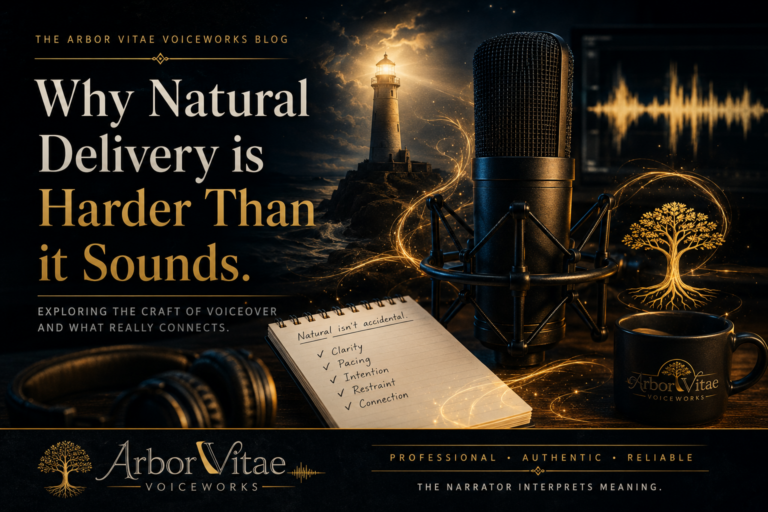
Why Natural Delivery is Harder Than it Sounds
I’m not an expert – just a student of the craft. What follows reflects what I’m actively learning, testing, and refining as I continue to grow in this field.
“Just make it sound natural.”
It’s the most common direction in the voiceover world, and honestly, on day one, it sounded like the easiest part of the job. After all, I’ve been talking “naturally” my whole life. How hard could it be to replicate that in front of a mic?
Five months in, I’ve realized that “natural” is actually the “final boss” of voice acting. As I state above, I’m not an expert yet – I’m just a student of the craft – but I’m learning that what sounds effortless to the listener is actually the result of highly intentional work.
The Paradox of the Booth
The difficulty lies in a strange paradox: natural delivery isn’t just casual, “off-the-cuff” speech. It’s a deliberate, controlled communication that has to feel unforced to the person on the other end. If it’s too polished, it feels stiff and rehearsed; if it’s too relaxed, it feels unstructured and the message gets lost.
Natural delivery lives in that narrow, quiet space between those two extremes. When you hit it, the listener stops hearing a “performance” and starts absorbing the message.
Tricks of the Trade: Finding the “Real” Voice
In my coaching sessions and practice hours, I’ve started picking up specific “tricks” to help bridge the gap between reading a script and actually speaking to someone. Here are a few that have changed the way I work:
- The “Who Am I Talking To?” Trick: A script is just words on a page until you decide who is listening. If I’m reading a commercial for a tech brand, I’m not talking to “an audience.” I’m talking to my buddy who’s frustrated with his slow laptop. Giving the listener a face makes the pacing and tone shift instantly from “announcer” to “friend.”
- Physicality and the “Check-In”: You can hear a smile, and you can definitely hear a stiff neck. Coaches have taught me that if my body is frozen in front of the mic, the read will be frozen, too. Using hand gestures, even if no one can see me, helps break up the mechanical rhythm of a script. It’s about being a “real person” first and a “voice” second.
- Ignoring the Punctuation: This was a big one for me. Written language and spoken language are two different animals. Sometimes, a period in a script doesn’t mean “stop.” It means “keep going because you haven’t finished the thought yet.” Finding where thoughts naturally begin and end, rather than just following the commas, is what makes a read feel like genuine human speech.
- The “Three-Word Lead-In”: Sometimes it’s hard to find the right energy just by jumping into the first line. A common trick is to say a short, unscripted phrase right before the recording starts… something like, “Hey, check this out…” or “You’re not gonna believe this…” I’ve been using various lead-ins depending on the context of the script and audience to help me get the right vibe. It sets the conversational tone so that when the first scripted word hits, it’s already grounded in a real moment.
The Invisible Voice
Everything I’m learning right now, from pacing and rhythm to the power of restraint, is aimed at one goal: becoming invisible.
When the delivery is truly natural, the voice actor disappears. You aren’t thinking about tone or vocal quality; you’re just thinking about the content. That’s the difference between a voice that “sounds good” and a voice that actually “works” for a client.
Looking Ahead
I’m still in the early stages of this journey, testing and refining these techniques every day. I’m not pursuing a “perfect” sound, I’m pursuing a “real” one. Because when a delivery feels natural, it builds something that every brand and narrator needs: trust.
If you need a voice that delivers clarity, consistency, and a message your audience understands, I’d love to connect. I’m always ready to get in the booth and see what we can build together.