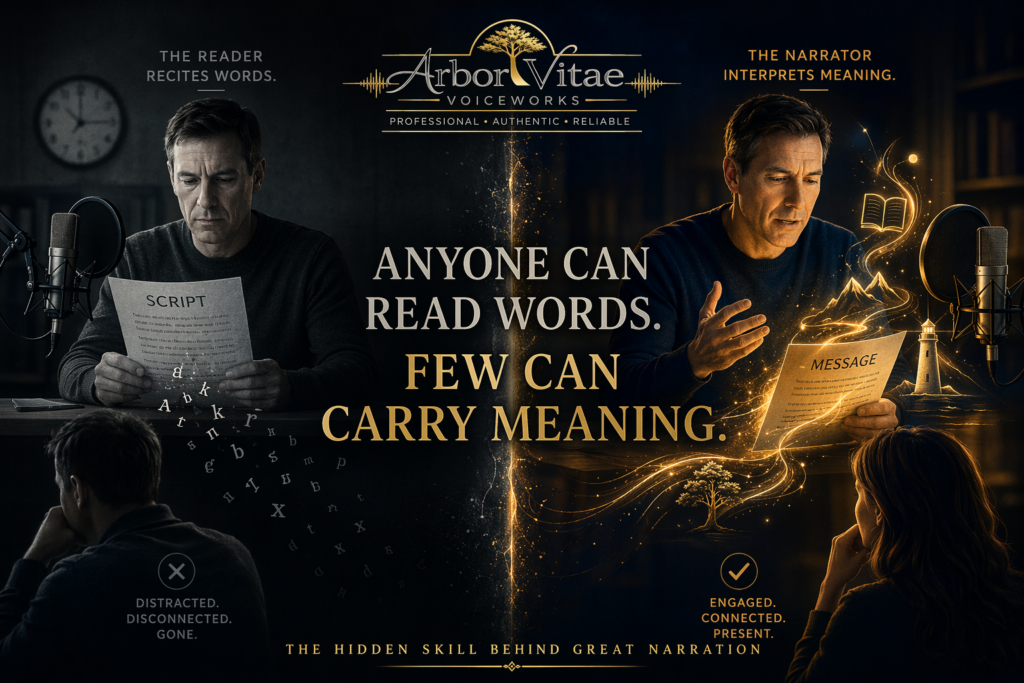
The Hidden Skill Behind Great Narration
Why sounding good isn’t enough – and what actually makes listeners stay
When people think about great narration, they usually focus on the obvious things – tone, clarity, pacing, and a “good voice.”
But here’s the truth most don’t realize:
The best narrators aren’t just speaking… they’re interpreting.
And that interpretation – the ability to understand and deliver meaning – is the hidden skill that separates average narration from truly compelling work.
It’s Not About the Voice - It’s About the Understanding
A pleasant voice might get someone to press play.
But it won’t keep them listening.
Great narration comes from understanding:
- What the message actually is
- Who it’s meant for
- And how it’s supposed to land
Two people can read the exact same script and sound completely different – not because of their voices, but because of how they understand the material.
One reads words.
The other delivers intent.
Narration is Translation, Not Recitation
Think of narration as a form of translation.
You’re not just converting text into sound – you’re onverting:
- Ideas into emotion
- Information into clarity
- Structure into flow
A strong narrator asks questions like:
- What is this really trying to say?
- Where should the listener lean in?
- What matters most in this sentence?
Without that layer of thinking, even technically perfect reads feel flat.
Why "Sounding Natural" Is Harder Than It Sounds
You’ll often hear the direction: “Just make it sound natural.”
But natural delivery isn’t casual – it’s intentional.
It requires:
- Knowing where emphasis belongs
- Letting certain words breathe
- Avoiding the temptation to “perform” instead of communicate
Ironically, the more someone focuses on sounding good, the less natural they become.
Because natural speech isn’t about performance – it’s about connection.
The Listener Can Tell
Even if they can’t explain it, listeners feel the difference.
They know when:
- A narrator is rushing vs. guiding
- A line is being read vs. meant
- The voice is present vs. just passing through
And in a world full of content, that difference matters.
Because people don’t stay for perfect audio – they stay for clarity and trust.
The Real Skill: Thinking Before Speaking
At its core, great narration comes down to one simple habit:
Thinking before speaking.
Not overthinking. Not analyzing every word to death.
But taking just enough time to understand:
- The purpose of the piece
- The rhythm of the message
- And the experience of the listener
That’s the hidden skill.
And it’s what turns narration from something people hear into something they actually follow.
Final Thought
Anyone can read a script.
But not everyone can carry meaning.
And in narration, meaning is what makes the voice matter.
If you need a voice that delivers clarity, consistency, and a message your audience understands, listen to my demos here.
Every project I take on is approached with one goal: make your message clear, natural, and easy for your audience to connect with.