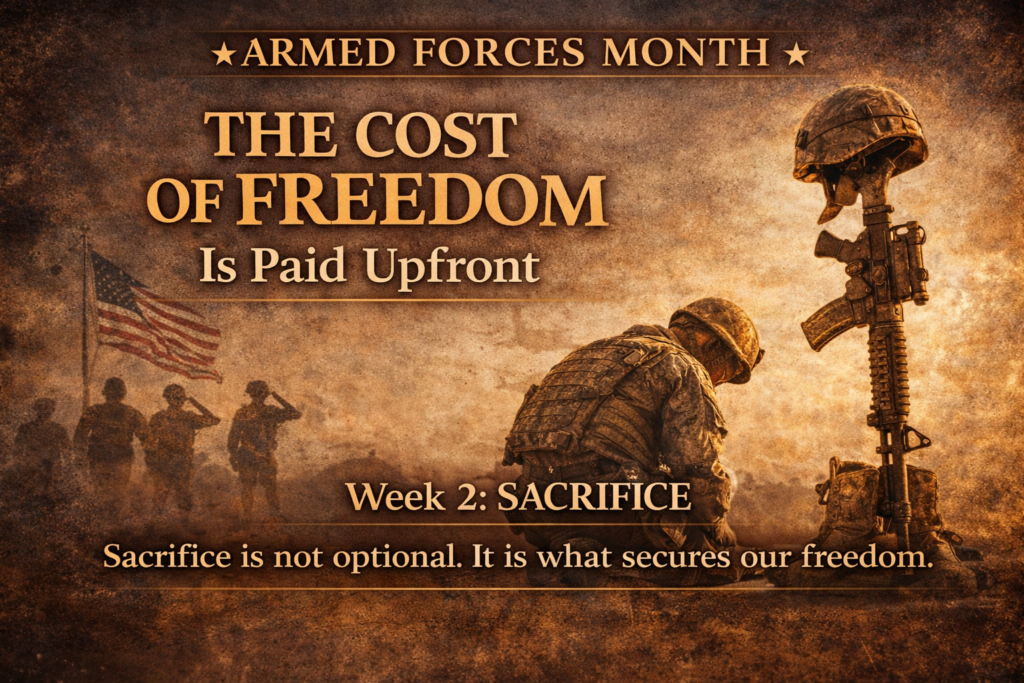
Arbor Vitae Voiceworks is proud to present this series as part of a joint effort with The Publius Project, connecting the realities of military service to the principles that sustain a free society. Together, the goal is not just to honor service – but to understand what it requires of all of us.
www.publiusproject.com
The Cost of Freedom is Paid Upfront
Sacrifice is not optional - it is what secures our freedom.
There is a tendency in modern life to treat freedom like a natural resource – as if it’s just always been there, like the air we breathe or the ground beneath our feet. We act as if it is self-sustaining, a permanent fixture of the landscape that requires zero maintenance.
But those of us who have spent years in uniform know a different truth: Freedom isn’t a given; it’s a lease. And the rent is due every single day, paid in a currency that most people aren’t willing to spend. It is a cost paid upfront, often by people whose names you will never know, in places you will never go.
Now, I’ll be the first to tell you: I don’t always support how our military is used around the world. You don’t have to agree with every foreign policy or every conflict to honor the person standing on the watch. My respect isn’t for the politics or the high-level strategy; it’s for the individual who stepped into the recruiter’s office, raised their right hand, and said, “I will go.” Whether the mission is perfect or flawed, the sacrifice of the individual remains absolute.
When we talk about “sacrifice,” the civilian mind usually goes straight to the ultimate one – the flag-draped coffin, the lone trumpet playing Taps, the finality of death. That is a sacrifice that deserves our highest silence and deepest reverence. But if we only focus on the end of a life, we miss the “living sacrifice” that thousands of veterans carry in their bodies and minds every single day.
Sacrifice is a slow burn.
It starts long before a deployment. It begins in the thousands of hours of training designed to strip away your civilian “softness” and replace it with something harder, colder, and more precise. It’s the mechanical repetition of loading a weapon until your fingers bleed in the cold, because that weapon has to feel like an extension of your own bones. It’s the chilling, quiet necessity of learning how to take a human life – not as a movie trope, but as a professional requirement.
Think about that mental shift for a second. Most people spend their lives avoiding conflict; a service member spends years inviting it into their mind, rehearsing it, and mastering it so that when the time comes, they don’t hesitate.
Then there is the mental tax of the “Target Mindset.” When you’re deployed, you don’t just “work” in a dangerous place. You live in a state of hyper-vigilance where your brain is constantly scanning for what’s wrong. Is that trash on the side of the road an IED? Is that person watching me from the balcony a scout? That level of awareness – the feeling of being a target every second you are “outside the wire” – is an exhausting, soul-crushing weight. You don’t just “turn that off” when the plane touches down back on U.S. soil. You don’t just stop being a target because you’re at a grocery store in the suburbs.
The Cost is Sensory.
True sacrifice is what stays with you after the uniform is folded and put in a box. It’s the smell of burning trash and jet fuel that triggers a spike in your heart rate ten years later. It’s the sound of a car backfiring that sends you into a crouch before you even realize you’re at home. It’s the PTSD that sits in the room with you like a ghost – the quiet, invisible weight of seeing things, hearing things, and smelling things that most people will never understand.
We hope they never have to grasp it. That is the irony of service: we sacrifice our own peace of mind so that the rest of the country can stay “soft.” We take on the nightmares so you can have the dreams.
To sacrifice is to decide, consciously, that something else matters more than your own comfort, your own safety, or your own sanity. It is a decision to carry a burden so that your neighbor doesn’t have to. In a world that is constantly telling us to “optimize” our lives and put ourselves first, the act of serving runs completely counter to the grain.
A society that forgets what real sacrifice looks like – the missed birthdays, the shredded nerves, the mechanical reality of war – will eventually lose the very things it is trying to preserve. Because eventually, it will no longer understand the price of the ticket.
Military service shows us, without any abstraction, that freedom is funded by the willingness of others to give up their peace so that the rest may live in theirs. The question isn’t whether sacrifice exists. It always will. The question is whether we are willing to look at the people bearing it and truly recognize the check they’ve already cashed on your behalf.
The next time you enjoy the simple peace of a quiet weekend, don’t just think about what that freedom gives you. Consider the training, the missed years, and the mental weight carried by those who paid for it upfront. Take a second to realize that while you’re enjoying the day, someone else is still settling the tab.
I’m extremely proud of my service to this nation and if you need a voice that brings that military discipline and delivers clarity, consistency, and a message your audience understands, I’m your man! Listen to my demos here.